Yemen is a Middle Eastern country located on the southern side of the Arabian Peninsula, north of Saudi Arabia, and south of Oman. According to the United Nations Development Program, an American education department that works to understand and study social and political turmoil around the world, Yemen was ranked 155 out of 156 on the official Economic Forum’s Global Gender Gap Index. (The official measure of relative gender gaps between men and women in different areas around the world.) Ranking 155 on the Gender Gap Index means that Yemen has one of the most extreme gender gaps in the world in terms of equality, such as severe limitations in economic participation, healthcare, and power.
Women living in North Yemen are faced with everyday sexual harassment, forced underage marriage, rape, and gender mutilation (FGM/C). Yemen has been under extreme civil distress since 2014, when the republican government was overthrown by an armed political group of Shia Muslims who call themselves “Houthis”. The Houthis claim their motives for taking control over Yemen were to rebuild a weak inner government and reform religious obedience, more specifically targeted towards women. In Yemen, there is no accurate ratio for reported rape and sexual abuse, because women and girls are extremely discouraged from reporting sexual abuse. Oftentimes, victims are blamed for public indecency, and the action would tarnish family honor. Seeing that the Houthis govern Yemen under a strict Shi’a Islamic religious order, the lawful punishment for raping a woman can range from 3 years in jail to death by firearm, but, since women are banned from owning cell phones, North Yemen makes it nearly impossible to provide enough proof to convict the man who defiled them.
A penal code is an organized body of legal procedures for prosecuting criminals in some countries. Yemen’s Penal Code is ruled over by the Shi’a Islamic order. It holds over 316 laws that are punishable by death, with punishments varying in intensity. Some of the more common death sentences include rape, murder, homosexuality, adultery, and apostasy (turning away from the Islamic religion). Because rape is so common in Yemen, there is far more legal protection for victims, such as Degree No. 12 of 1994 “Concerning Crimes and Penalties”, which clarifies that men can avoid sentencing, so long as they marry their victim, disproving adultery. Other crimes like homosexuality or apostasy can range from 100 whip lashes to death by stoning.
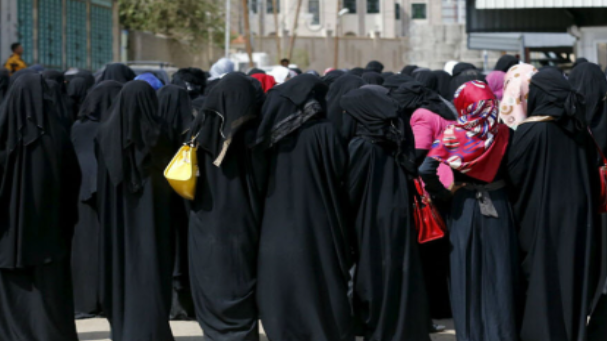
The Houthis have been working to keep women tied down to strict traditional rules to prevent them from advancing before men. The rule system the Houthis have founded for women is called Mahram, which translates to ‘forbidden’ in Arabic. Mahram are set rules created specifically for women who live in North Yemen. Mahram has made it so women cannot travel without their husband or man of relation, and if women are caught traveling in public areas without a male escort, they can be beaten, stoned, or put into a detention facility and held until a man of relation comes to claim them. Women are forbidden from leaving their homes without wearing a niqab to ensure all skin and hair is left unseeable by men around them. This is done to make it easy for men living in Yemen to flee from lustful thoughts.
North Yemen retains further authority over women through a separate department of policy consisting of primary female officers called the Zainabiyyat. The Zainabiyyat has been created to ensure that women are held accountable to all Mahram laws while being outside of their homes. The Zainabiyyat ensures all women are dressed in an appropriate dress code after leaving their homes. Anything outside of an all-black niqab, covering hair, face, eyes, and skin always, plain all-black fabric flats (heels, open-toed shoes, tennis shoes, and boots are banned for female attire) is unacceptable and deemed illegal to be seen without. Jewelry, glasses, decorative lace on a niqab, and color displayed on any article of clothing are also deemed unacceptable and outlawed. Zainabiyyat are also required to correct women attempting to enter male-only civic spaces, like restaurants, public bathrooms, stores, and buildings. The Zainabiyyat are paid close to nothing and only exist as a legal loophole. In Yemen’s Islamic constitution, there are restrictions held against men entering residence unpermitted, but women do not share that restriction. So, the Houthis invented Zainabiyyat to deflect constitutional restrictions. Men have several restrictions legally and religiously against public abuse towards women whom they are not married to, but Zainabiyyat does not have a restriction and is permitted to same-sex assault, meaning Zainabiyyat has the authority to publicly punish and beat women in the name of ‘justice’ and invade homes without consent through legal omission.
Early Houthi control outlawed numerous medical procedures, medications, and healthcare treatments for females. Restrictions on contraceptives quickly became the Houthis focus. As of 2017, IUDs, contraceptive injections, hormonal coils, birth control pills, and condoms were completely prohibited from female use in North Yemen, due to religious contradictions. The ‘Birth Control Ban’ has been at fault for economic, health, and domestic turmoil. Short inter-pregnancy periods cause spikes in maternal mortality rate, death, and infection spikes from unsafe home abortion, and the economic burden of unwanted pregnancy falls on families living with severe poverty, limited resources, and nationwide famine. In Yemen, a woman dies every 2 hours from preventable pregnancy-related causes. The contraceptive ban has created an irreversible amount of nationwide grief for men and women living in Yemen, as a violation of freedom and human rights.
It’s been 12 years since the Houthi takeover of the Yemeni Republic, and the people have faced traumatic suffering in an injustice they did not ask to be a part of. Every day, Houthi rule is a constant violation of human rights. So many brave women and girls have put their lives on the line to bring justice to their country. Since 2015, the European Union and the United Nations Population Fund (UNFPA) have been working to support the justice of women and girls living in Yemen by providing underground lifesaving healthcare, food, shelter, and money to support families suffering from the impact of war. As of late 2025, a total of 26 ‘underground’ maternity and general healthcare facilities have been built and are being managed across North Yemen to ensure unrepresented women are receiving all the healthcare they need, whether maternal or physical. Thanks to these efforts, over 19,000 women endured safe deliveries, and 6,500 women have received life-saving emergency caesareans.