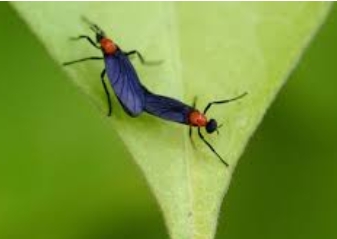
Plecia nearctica are the little black bugs with the red dot body that you’ve probably been seeing everywhere. These bugs are commonly known as “lovebugs”. Lovebugs are an invasive, harmless exotic species that thrive primarily in southern states of America during April/May and August/September. This species originated in central America and moved south during the 1920s; their diet consists of decaying vegetation and plant nectar, making them active contributors during pollination as well as excellent decomposers.
Lovebugs earned their name from their unique breeding behavior; male and female lovebugs will attach themselves back-to-back and remain in mobile tandem for 3 days – making them notorious for constant breeding.
While you can essentially see them anywhere, lovebugs are attracted to heat, vibration, light colors, moisture, and decaying matter – these spots are ideal for laying eggs to hatch. A single lovebug typically lays 400 to 600 eggs each mating season, making ‘invasion’ just a part of life.
For more information, see this article from the University of Florida’s Institute of Food and Agricultural Sciences Extension: https://sfyl.ifas.ufl.edu/natural-resources/sustainability-love-bugs/#:~:text=Lovebugs%20are%20mainly%20a%20nuisance,Mosquitoes