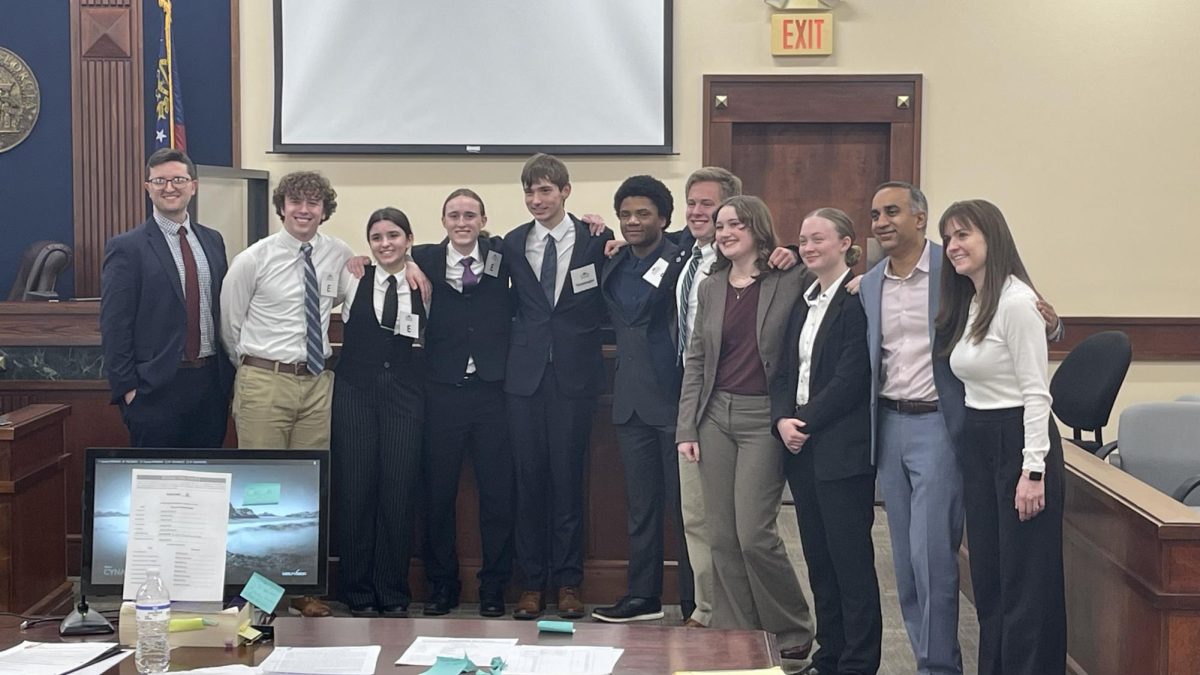
Cartersville High School’s Mock Trial team had its first competition on Saturday, February 7th, at the Floyd County courthouse. Led by Judge Samir Patel and Attorney Zack Moore, the team consists of eight juniors and seniors playing the roles of attorneys and witnesses in a pretend murder case, State of Georgia v. Logan Haynes. Members include Issac Evans, Sofia DeRenzo, Jack Johnson, Ethan Nix, Emery Ponder, Maggie Sheffield, King Williams, and Brayden Yrabedra. The team placed second at the competition, with seniors Issac Evans and Sophia DeRenzo winning awards for Best Attorney and Best Witness, respectively. The team went on to compete again on Saturday, February 28th, in Dalton, Georgia.
A mock trial is two things. It’s stressful, and it’s a mental challenge. But that’s what makes it fun.
When going as an attorney, you do two things to the witnesses: a cross and a direct. A direct is when the witness on the stand is called forward by your side and typically is somewhat friendly to what you are trying to prove. You ask open-ended questions, work with them during the preparation for the trial, that sort of thing. Your interaction with them in court seems more like a conversation than an interrogation. That is not the case for a cross.
When doing a cross, you interact with a witness brought forward from the other side. You don’t know this person, but you are given their statement and are made to make holes in their story, make them seem untrustworthy. You hammer down on anything they say in direct or in their statement. As an attorney, you are fighting them every step of the way to prove your point. If they have a criminal history that is applicable to be brought forward, you’d better bring it forward, and you better be ready to defend its use in court, as the opposing counsel will likely object to the history’s involvement to ensure their witness stays trustworthy in the eyes of the jury. A good witness on cross will also waste your time, add small details that have no relation to the case, and try to throw you off. So, you must ask simple, short, yes-or-no questions to corner them into saying what you want them to say.
Obviously, there are differences between a mock trial competition and an actual trial. Namely, no one is going to prison, but matters such as pretrial motions, including a motion to suppress or dismiss, are not involved. You can’t have a competition if a case is thrown out. Rule 807, which permits the usage of certain hearsay evidence if provided in advance and shown to have sufficient levels of trustworthiness, is modified to be applicable to a trial without being put forward in advance of the trial, as you have no idea who your opposing council will be and therefore cannot get the information to them ahead of the trial.
For the first competition, we arrived at the Superior Court of Floyd County, and it was a tad chaotic. When I had passed through security, I had wondered why there was a small crowd of adults just standing on the first floor when the competition was on the third. I entered the elevator and went up.
All teams were packed into the third floor of the building, and when I say third floor, I mean the singular, thin hallway on that floor. You had groups doing last minute prep on cramped, hard wooden benches, some bent over the floor to look at notes. Luckily, members of our group managed to snag a small room about the size of a closet.
Each team had three rounds to show off what they knew. The first round was our team’s prosecution, second was defense, third was prosecution again. We won second place and advanced to the next round.
At the next competition, things were harder. Our first round went well with our prosecution, but the second round was rougher. Since we had done so well, we were paired with a harder opponent, who had been unfavorably mentioned by members of the team who had participated last year. I would soon learn why.
Before we had gone to the competition, we had practiced with certain objections that may have come up during the trial. My direct witness, for instance, had testimony that contradicted another witness’s testimony. This is allowed under Rule 801 d, which states that so long as the first witness was crossed on that statement, the second witness was allowed to give their opinion. We needed to know the rules and explain how that rule applied to the current case in order to get the judge to overrule the objection. Otherwise, that entire piece of testimony can be thrown out.
The first thing they objected was to be me bringing up an Aggravated Assault charge against my cross-witness. Since the witness hadn’t been charged as guilty or innocent, technically, it shouldn’t get in. However, the charge was being made by the state for which the witness was testifying for. The witness had already gotten loansharking charges against them dropped due to their testimony, which I made sure to mention, but when you testify for the person charging you with something, the person charging you has a clear show of bias towards you. So, using this and Rule 607, I was able to successfully argue the assault charge into play.
This is slightly unrelated, but that specific witness was written to be of Russian descent; they had been born and raised in Brooklyn. The person playing the witness gave them a very strong Russian accent. It took all my willpower not to call that out in front of God and everybody.
The next objection should have been easier. My direct witness had spoken with the person murdered before they had died, and the person who was killed confessed that a loan shark they had borrowed five hundred thousand dollars from was likely going to come after them soon. They had paid back a little over two hundred and fifty thousand, but they had stolen that from a business they co-owned, and that business was in the red. Now, technically, a witness cannot testify as to what someone else says. However, under Rule 804, declarant unavailable, if a witness is unavailable, someone else can, in fact, testify as to what they said. Declarant unavailable can be used when the witness is dead, specifically found under 804 a1. So, when the opposing counsel objected on the grounds that the person who made the statement was not, in fact, my witness, I told the judge that Rule 804 declarant unavailable gave my witness the ability to testify as to what the now deceased person had said.
This is where things began to go wrong.
When I said that, the opposing counsel told the judge that 804 required another prerequisite that we had not met. They did not name that prerequisite. Now, there is a requirement that a declarant unavailable cannot be used if the person had murdered the person they are quoting. However, my witness was not the one charged with the murder, and even if they were, the law states that they are innocent until proven guilty. In the trial for the murder, the person on trial can still testify as to what the person murdered said to them. Looking back, I believe this is what they were talking about. However, at the time, I couldn’t fathom what in God’s name they were talking about, unless the person murdered was still alive, and in that case, why was my client still being charged with felony murder of someone who wasn’t dead?
Looking back, I should have asked for clarification; however, I stood by my original statement, which was correct. Unfortunately, that objection was upheld, and the testimony was thrown out.
The worst thing in a Mock Trial is an attorney who is wrong but still manages to convince a judge that they’re right.
Fortunately, the testimony of my direct witness wasn’t their only testimony. Unfortunately, that same lawyer would continue to be a problem. The example I used earlier in concern to Rule 801 d came into play here, as my cross witness had a different account than that of my direct witness. I had made sure to cross them on the information they provided, but I was still stuck on the prior objection. When you’re shaky like that, it’s blood in the water. I did what I was supposed to do, but the opposing counsel lied and said the testimony wasn’t applicable regardless, and did the Mock Trial equivalent of “nuh-uh.” Unfortunately, the rest of the testimony was also thrown out. Thankfully, the witness was excellent at their job and still managed to sneak testimony in on cross-examination, which the opposing council was unable to throw out again.
Overall, it was fun, but I would hate having it as my job. Speaking as someone looking to be an engineer in the future, I can see how other people may enjoy it as a job, but for me, I would come home angry every day and argue with myself in the mirror. I did that for a good thirty minutes after driving myself home from the meet. It wasn’t even a real case.