


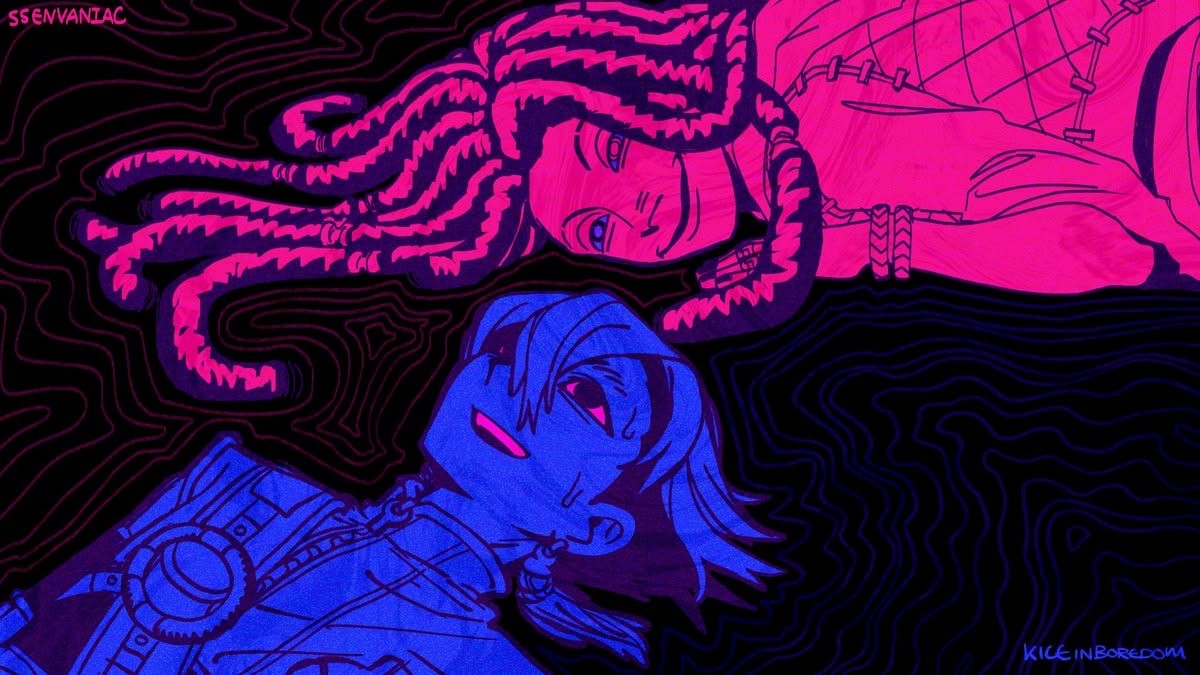
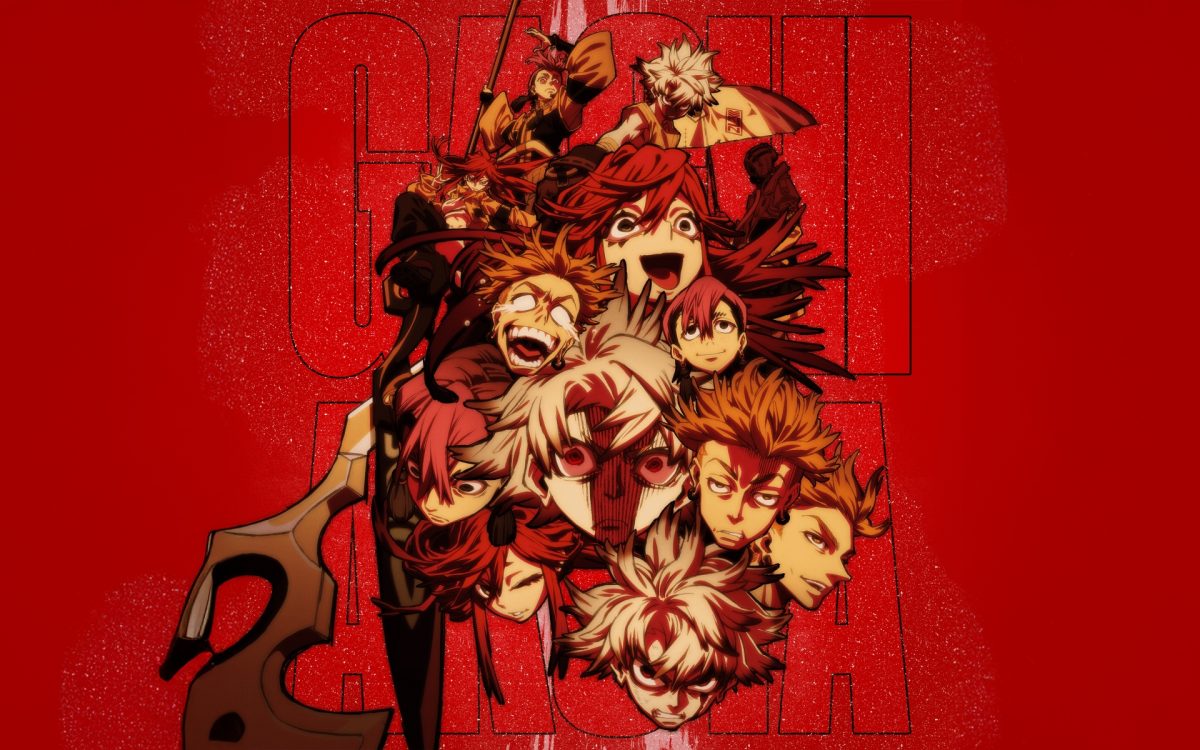
What is Janka? Janka is the ship name for the characters Zanka Nijiku and Jabber Wonger from the dark-fantasy manga: Gachiakuta. The ship has multiple names — Clawbite, Poison Oak — but nothing quite compares to Janka. Now that’s out of the way, I have one thing to say.
Jabber Wonger and Zanka Nijiku are written for one another, whether that connection is queerly implied, platonic, or romantic. In any of these interpretations, they still feel fundamentally designed to exist alongside each other.
Let’s start with Zanka.
Zanka wants to be perceived as the calm, laid-back genius—the kind of person who doesn’t have to try as hard as everyone else. Born into the prestigious Nijiku family, he was raised from birth to join the Hell Guard alongside his siblings, Goka Nijiku and Kyouka Nijiku. Because of this, he enrolled in the Central Hell Guard Training Academy in the Kamuatari District. As a trainee, he quickly rose to become the top student, as was expected of him. He was constantly praised but also envied. Many assumed he was simply a naturally talented prodigy who didn’t need to work for his success. In reality, that wasn’t true. Zanka trained relentlessly, studying day and night to reach that position.
That effort gave him pride and perhaps even a bit of cockiness because now he finally felt close to the level of his siblings. That confidence was short-lived, however, when another trainee, Hyo, joined the academy and surpassed him in every way. Zanka tried to handle the losses. He tried to accept watching someone else receive the praise that used to belong to him. Yet envy slowly crept in. No matter how hard Zanka worked, Hyo’s talent seemed effortless.
Externally, he kept the same calm persona: “This is fine. We can’t win all these things. I just need to train harder.”
Internally, however, he completely collapsed. After another loss, he isolated himself and slammed his head against a wall until it bled, overwhelmed by the realization that Hyo was simply better. The moment that truly solidified Zanka’s crisis comes during the weapon selection test. Out of every weapon available, Zanka chooses… a stick. He assumes the exercise is some kind of deeper, existential test—that the stick must represent hidden potential or unconventional thinking. Meanwhile, Hyo chooses a katana.
In a way, it is an existential test.
Zanka realizes that he himself feels like that stick: something pretending to belong among real weapons. When he looks around and understands the stick was nothing more than accidental trash, the realization devastates him. Losing physically was one thing—but now he feels he has lost mentally as well.
He begins to see himself as a fraud.
Instead of asking healthy questions like “What went wrong?” or “What can I improve?” he asks something far more dangerous:
“What am I?”
Technically, he is a Nijiku. But in his mind, he becomes the lowest of them all—someone who doesn’t deserve the family name. If strength defines the Nijiku, then what is he without it? The answer he lands on is brutal: he sees himself as nothing more than a rotting pile of garbage.
Those losses don’t simply reveal a weakness; they rewrite his identity. Zanka goes from believing he’s exceptional but hardworking to believing he was never special at all. From there, he spirals into a mindset of mediocrity. Even after joining the Cleaners, that mindset follows him. It seeps into his personality and worldview. Perhaps it softens the blow of his failures, but it also makes him desperate for validation from those around him, including the man he claims saved him: Enjin.
In episode four of the anime, we are introduced to Jabber Wonger.
Jabber is a chaotic, psychotic man labeled as a masochist, and the label is exact. He thrives on the thrill of combat, especially the thrill of being beaten down by someone worthy. To him, Zanka is exactly that: a formidable opponent, someone worth fighting even if it costs him his life. In every fight they’ve had, Jabber has come out on top. Yet Zanka doesn’t simply resent the losses. Something about Jabber compels him to push himself harder than anything else ever has.
Zanka even admits this directly:
“I can’t remember what the plan was, but the second I saw him—whatever was going on didn’t matter anymore. Everything was replaced with a single thought.” Fighting Jabber pushes Zanka to his absolute limit. In those moments, the mediocrity he believes in disappears, replaced by the painful possibility that he might still become more.
Zanka is sadistic in his own way. Hurting Jabber makes him feel powerful—like he still has the will to fight. They are two sides of the same coin: a sadist and a masochist. At this point you might ask, “How are they written for one another if Zanka doesn’t seem as obsessed with Jabber?”
But that assumption isn’t entirely true.
A clear example appears when Jabber poisons Zanka and leaves him behind. Zanka is not only furious because he was poisoned, but because Jabber left him lying there like an afterthought. Despite the poison, Zanka drags himself to the fight between Jabber and Rudo. Yes, part of it is to protect Rudo, his student, but it’s also because he feels there is a score to settle with Jabber.
This mindset appears again when Zanka reflects on how satisfying it is to defeat geniuses. Beating Jabber matters to him. It matters so much that, even while poisoned, he hallucinates himself standing up again just to continue their duel.
There’s another telling moment when Zanka remembers Jabber suggesting he should have fought another Cleaner instead. Zanka isn’t just upset that he lost — he’s upset that Jabber found the fight underwhelming. Put simply, Zanka wants to matter to Jabber. He wants to live up to the expectations Jabber places on his opponents.
Another example appears when Mymo lists everyone’s weaknesses. He specifically points out Zanka’s losses to Jabber. Mymo’s entire role is exploiting insecurities and psychological pressure—he wouldn’t bring this up if Zanka didn’t genuinely care about it.
All of this suggests that Zanka does care deeply about Jabber’s perspective of him. He may not express it as openly, but the inability to defeat Jabber weighs heavily on his pride and ego.
With Jabber, however, the obsession is explicit.
Jabber’s character description outright states that he has a lingering fixation on Zanka. But it goes deeper than simple obsession—Jabber sees immense potential in him. He believes Zanka can become far stronger than he currently is, strong enough to eventually defeat him.
And that’s exactly what Jabber wants.
Fighting Zanka is fun for him. For most of his life, Jabber has fought powerful opponents, becoming so strong that he eventually struggled to find anyone who could truly challenge him.
He’s searching for someone who can match him.
In Jabber’s mind, Zanka is that person—someone who might one day equal or even surpass him. That’s why he becomes so excited when he thinks Zanka might defeat him during the Trash Beast incident.
Unlike Zanka, Jabber is very open with his emotions. While Zanka buries everything inside his own mind, Jabber says exactly what he’s thinking. The contrast between them is striking.
Jabber enjoys fighting many opponents, but he is never quite as excited as he is when fighting Zanka. He even goes out of his way to hype Zanka up—his enemy, someone he is technically supposed to destroy.
And that is why I believe they are written for one another.
They push each other to their limits. They reflect each other’s desires and insecurities. Whether they make each other better or worse, their existence in the story constantly circles back to the other.
In the end, Zanka and Jabber feel less like random rivals—and more like two people deliberately written to collide.











Sen • Apr 21, 2026 at 1:48 pm
Hey I’m one of the artists in the art that you embedded to this article. I do not mind it being used, but please properly credit us in a text caption!
We can be found in X, or Twitter, by @kiceinboredom and @ssenvaniac.
Love this article by the way 🙂
Dianna Long • Apr 22, 2026 at 12:30 pm
Hello Sen! Thank you for bringing this issue to our attention. You are absolutely in the right here; artists and photographers should be given credit for the hard work they have put into their craft.
We are still learning and growing as a site, so we really appreciate any accountability and kind feedback from our readers. The issue should be resolved now; credit has been added below the artwork in a text caption. If there is anything more we can do at Chipper to acknowledge and support other artists, please do not hesitate to reach out.
Dianna Long • Apr 22, 2026 at 2:27 pm
Hello, I’m the author of the story. This was brough to my attention and I wanted to give a formal apology for not crediting you or kice properly. I had asked someone about the artist and was mistakenly directed to the wrong person, who told me they didn’t want credit. I should have double-checked before posting.
I truly appreciate your work, and I’m sorry for the oversight. I hope you have a wonderful day.